Grant Application Excerpt
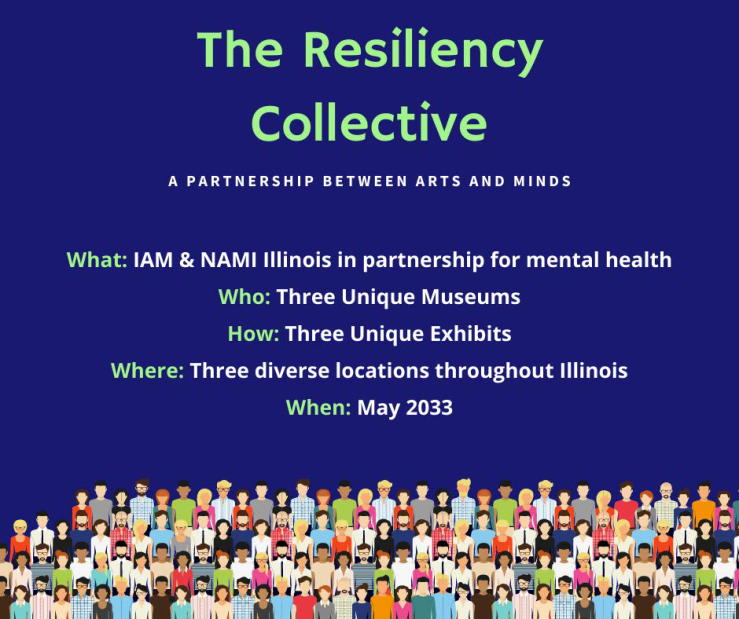
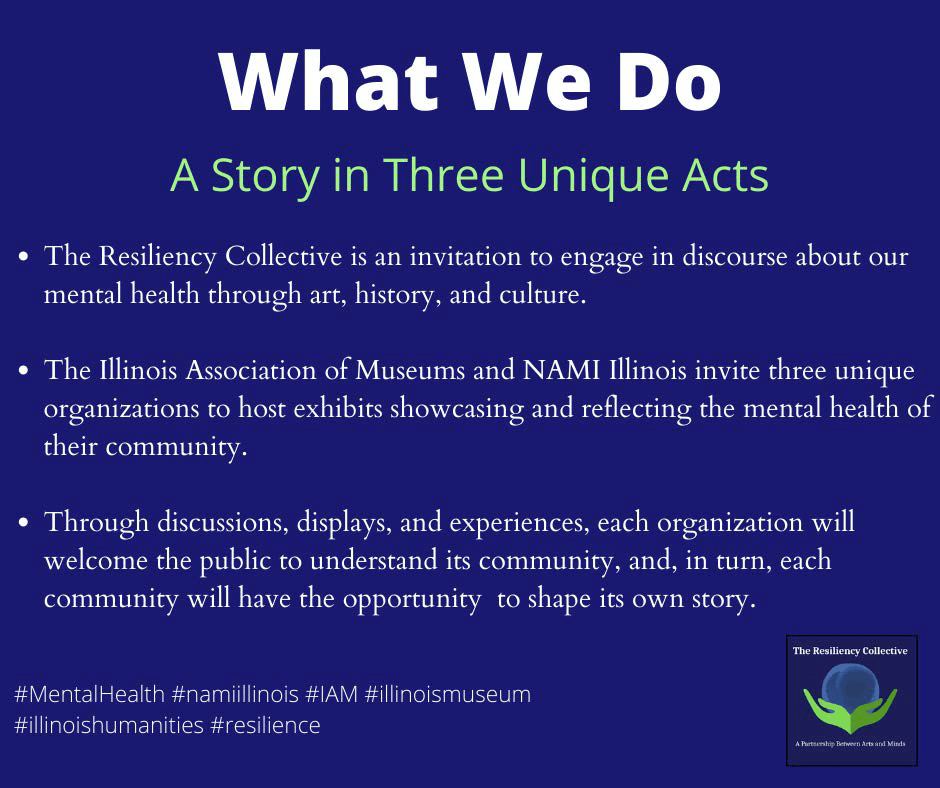
This project is a demonstration inviting the public to participate in humanities-focused discourse about mental health topics. The goal of this project is to seize on this unique moment of collective health awareness in a way that destigmatizes mental health topics and fosters engagement in community healing through art, culture and the humanities. Led by the Illinois Association of Museums and NAMI Illinois, the project joins our state’s museum and mental health communities to advance participation in cultural experiences exploring mental health issues and resilience. The project creates an adaptable template for museums and NAMI affiliates to show how the humanities can cultivate healing and recovery.
Each affiliate brings a perspective and network of relevant contacts to reflect targeted audiences in overlapping regions throughout Illinois. Collaboration between these sectors opens the door to marginalized populations disengaged from one of these two domains, allowing audiences from each to experience reflection and support from the other. IAM and NAMI will combine knowledge of humanities engagement and mental health resources to target community-specific mental health issues. Ultimately, this project serves as a collaborative model for the humanities and mental health sectors, laying the groundwork to serve their communities in new and relevant ways.
Through meetings with three targeted partner organizations from three diverse locales and disciplines, IAM and NAMI will gain relevant insight into regional demographic mental health needs. This insight will help partner museum leaders engage their audiences in mental health discourse and help mental health leaders create humanities-focused resources and experiences to better reach stigmatized audiences. The selected partner museums will represent urban, rural and suburban locations. Targeted partners will also represent different disciplines, including historical, art-focused, cultural, or age-specific categories.
The project envisions three exhibits running simultaneously for the duration of one month at three partner museums in an urban, rural, and suburban location. Each museum’s chosen format and content is tailored to their needs, capabilities and demographics.
Partner museums will host an exhibit along with either one or more experiences or events focused on a relevant mental health topic. Each will receive a stipend to create their exhibits, along with a physical element, including pallets that can be suited to their own design. They may also elect to host one or more events, discussions and/or activities to engage their audience in verbal and non-verbal forms of reflection or expression.
Each partner represents a unique type of institution. Our model seeks to demonstrate the diversity in location, discipline and population served. We have chosen sites that reflect urban, rural and suburban areas of the state to reflect a wide background and audience pool. We believe the strength between a humanities and mental health sector partnership could pave the way for both museums and mental health organizations to deepen their connections within their own communities and engage new, harder-to-reach participants in each sector.
Legal Blog Excerpt
The face of “child custody” is changing. What we once used to call custody agreements now is referred to as “Allocation of Parental Responsibilities.” And instead of “visitation,” the new terminology is “Parenting Time.” The change may at first seem wordy, but when viewed in the context of what the laws are actually supposed to do, makes more sense.
Under the updated Dissolution of Marriage Act, these terms, in addition to “Relocation” and “Parenting Plans,” represent clearer distribution of responsibility and a code of respect for the most affected party: the children1. Considering the previous term “custody” is also the term used in criminal law, it makes sense to refer to legal language involving children in a different, and more responsible way.
This newer terminology also better identifies what it expects from both parents involved: responsibility and time spent with the child. In the past, where custody agreements focused on time and were divided according to the parents’ schedules, the new framework of allocation of parental responsibility focuses on the best outcome for the child and places the focus on the parents adapting to that outcome. The language change reflects this by shifting the idea of a child in custody (as though criminal) to the parents’ roles, thus shifting from a child-centered title to a parent-centered one. So the terms go from having “child” in the name to having “parent” in the name, directing the action where it is needed.
The two governing principles of the law are decision making and care taking regarding the needs of the child. Determining what qualifies under each may be decided in a couple’s agreement and/or mandated by the state. In Illinois, these include the child’s nutritional needs, safety needs, emotional needs and wellness needs. It also weighs a child’s medical, developmental and disciplinary needs, among others.
As for a “parenting plan,” this is the agreement allocating how the care will be spread between parties, with some taking the traditional path more akin to custody (which days the child spends with which parent and addresses how decisions will be made between parties with regards to religion, time spent, step-parents, etc.
 Undeniable Narrator